
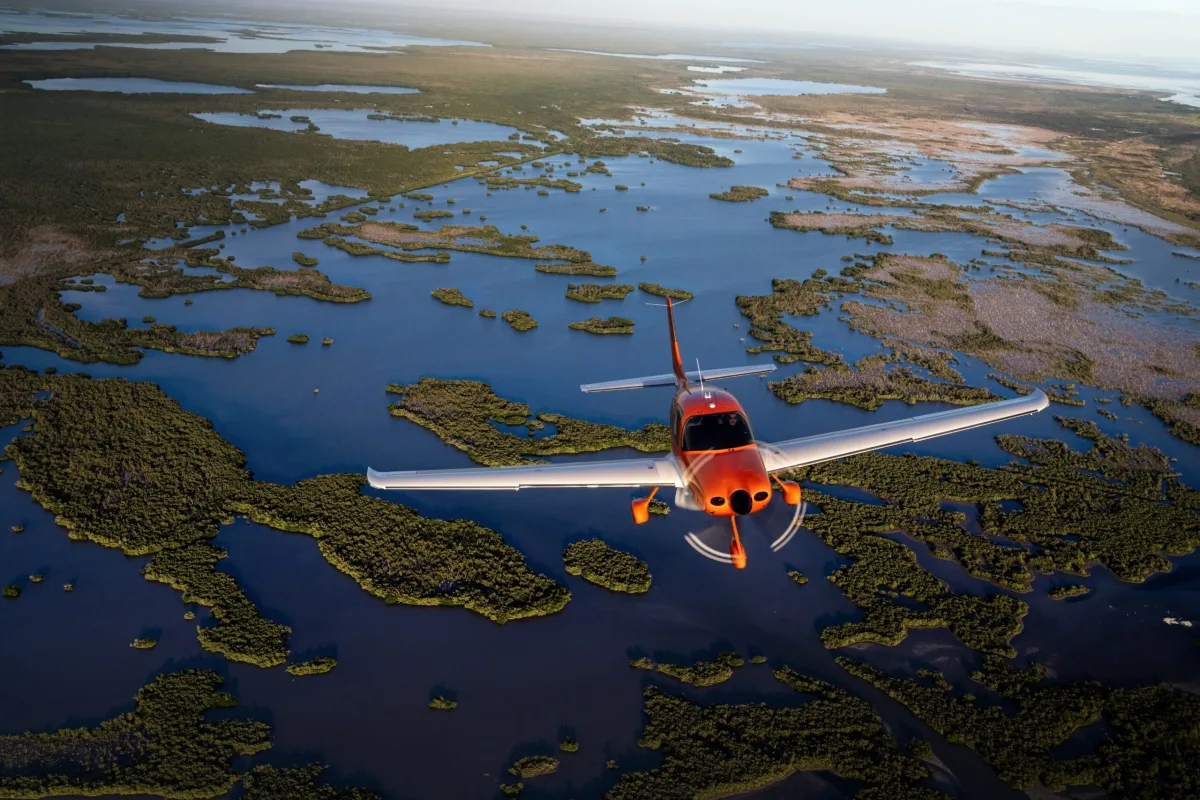
Duluth, Minnesota, 1994. Two brothers — Dale and Alan Klapmeier — found Cirrus Design with one idea: build a private aircraft that is safer than anything that exists. Three decades later, Cirrus Aircraft is the world's largest manufacturer of certified single-engine piston aircraft — and the SR22T is its flagship.
Cirrus SR22T — Technical Specifications
- Powerplant: Continental TSIO-550-K (315 HP, turbonormalized)
- Maximum Speed: 369 km/h (199 ktas at FL250)
- Cruise Speed: 333 km/h (180 ktas, 75% power)
- Range: 1,947 km (1,051 nm) with reserves
- Max. Altitude: 25,000 ft (without supplemental oxygen up to approx. 12,500 ft)
- Passengers: Pilot + 3 passengers (+ small optional 5th seat)
- Useful Load (full fuel): approx. 270 kg
- New Price: approx. USD 1.05M (2024, GTS configuration)
The CAPS System — Safety as a Design Principle
Dale Klapmeier survived a midair collision in 1985 — this shaped the DNA of Cirrus to this day. The Cirrus Airframe Parachute System (CAPS) is not a last resort but a core safety feature: a ballistically deployed parachute system that safely brings the entire aircraft to the ground in case of engine failure, stall, or spatial disorientation.
The track record: over 100 confirmed lives have been saved by CAPS (as of 2024). The activation rate is approximately one per year. And — crucially — the survival rate during CAPS deployments is significantly higher than during conventional forced landings under similar conditions.
Perspective+ — Jet-Level Avionics
The current SR22T cockpit is based on the Garmin Perspective+ system — a customized version of the G1000 derivative with two 12-inch touchscreens. The integrated autopilot (GFC 700) can fly complete ILS approaches, stabilize the flight path, and automatically intervene during descent trends. The Synthetic Vision System (SVT) displays terrain, traffic, and obstacles in an intuitive 3D image.
For single-pilot IFR, the Perspective+ system is a genuine workload reducer. Since 2020, Cirrus has also offered the "Safe Return" feature: in case of pilot incapacitation, a passenger can press "Land Safely" on the touchscreen — the system then autonomously flies to the nearest suitable airport, communicates with ATC, and executes an automatic landing.
The Typical SR22T Buyer
Cirrus has cultivated and simultaneously created a specific buyer profile: the "affluent owner-pilot." Typically an entrepreneur between 45 and 65 years old with their own pilot's license (usually IFR-rated), who flies their own aircraft — for business trips, weekend getaways, and occasional holidays. The SR22T is their Ferrari and their tool in one.
Cirrus supports this target audience with its own training program (Cirrus Standardized Instructor Program, CSIP) and a global dealer and service community. The Cirrus Owners and Pilots Association (COPA) is one of the most active user communities in aviation — a valuable network for pre-owned buyers and newcomers.
Pre-Owned SR22T Market
The pre-owned market for Cirrus SR22T is one of the most liquid in general aviation. Well-maintained examples (under 1,000 hours TT, current avionics) change hands quickly. Typical prices:
SR22T Pre-Owned Prices (Indicative, 2024)
- 2010–2014 (G5 Generation): USD 380,000 – 520,000
- 2015–2018 (G6): USD 520,000 – 700,000
- 2019–2021 (Perspective+): USD 700,000 – 850,000
- 2022–2024 (Safe Return): USD 850,000 – 980,000
Prices highly dependent on total time, engine status (SMOH, TBO proximity), and avionics configuration.
The Cirrus SR22T is not the fastest, longest-range, or most luxurious entry into private aviation — but it is the most thoughtfully designed. CAPS, Perspective+, Safe Return, and a worldwide service network make it the safest and best-supported option for owner-pilots.
Anyone who learns to fly and plans to stay in general aviation long-term will sooner or later find themselves in the Cirrus world. That's no coincidence — it's excellent product design combined with a unique ecosystem.
