
Overview
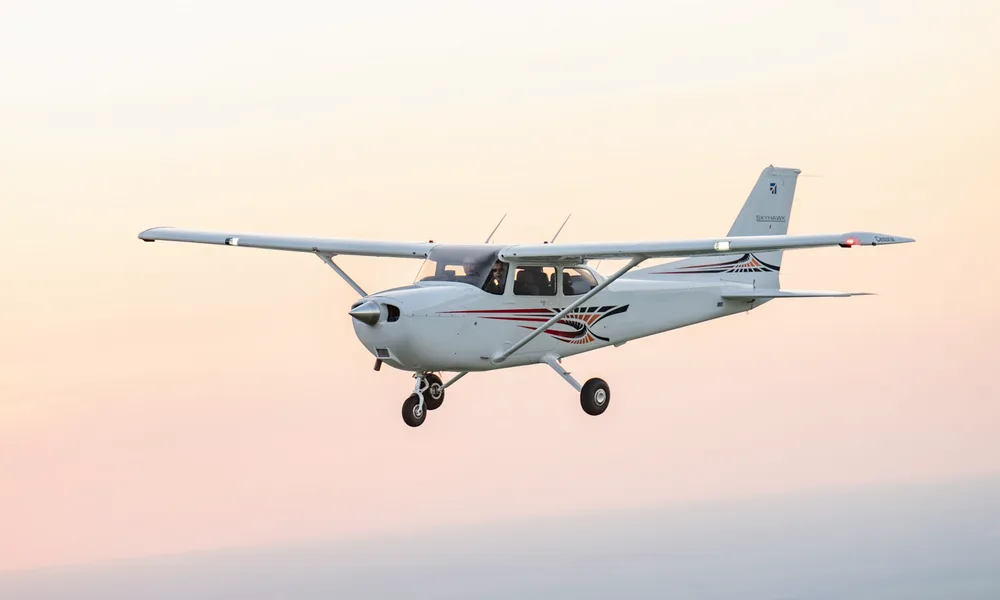
The Cessna 172 Skyhawk is the most produced aircraft in aviation history, with over 44,000 units built since 1956. Powered by a 180 HP Lycoming IO-360-L2A engine, this four-seat, high-wing, single-engine airplane has become the universal standard for flight training and personal aviation worldwide.
With its stable flight characteristics, forgiving stall behavior, and tricycle landing gear, the Skyhawk offers an ideal platform for student pilots while remaining a capable cross-country tourer. Its high-wing configuration provides excellent downward visibility and natural stability, making it one of the safest and most approachable aircraft ever designed.
History & Context
The Cessna 172 first flew on June 12, 1955, and entered production in 1956 as an evolution of the taildragger Cessna 170. The addition of tricycle landing gear was a decisive innovation that dramatically simplified ground handling and broadened its appeal. By 1963, Cessna had already produced over 10,000 units.
Production paused in 1986 due to rising product liability costs in the US market, but resumed in 1996 after the General Aviation Revitalization Act was signed into law. Since then, Cessna (now Textron Aviation) has continued refining the Skyhawk with modern avionics, fuel-injected engines, and glass cockpit options, while preserving its proven airframe and flight qualities.
Development & Updates
The current Cessna 172S Skyhawk SP features a 180 HP Lycoming IO-360-L2A fuel-injected engine and is available with the Garmin G1000 NXi integrated flight deck as standard. This glass cockpit replaces traditional analog instruments with two large LCD displays, offering synthetic vision, integrated GPS navigation, and engine monitoring.
Recent updates include USB charging ports, improved LED lighting, and enhanced interior options. Textron Aviation continues to offer the Skyhawk as its primary trainer and entry-level four-seat aircraft, maintaining backward compatibility with decades of established maintenance infrastructure and pilot familiarity.
Flight Characteristics
The Cessna 172 is renowned for its benign handling qualities. The high-wing design provides inherent lateral stability, and the aircraft exhibits predictable, gentle stall characteristics with ample aerodynamic warning before the break. Control forces are light and well-harmonized, making it comfortable to fly for extended periods.
In the traffic pattern, the Skyhawk is easy to manage with full flaps providing effective drag for steep approaches. Crosswind capability is adequate for most training environments, though the high wing does present more surface area in gusty conditions. Cruise speed is approximately 124 knots at 75% power.
The aircraft is particularly forgiving of minor pilot errors, which is precisely why it has become the world's most popular trainer. Its stability also makes it suitable as an IFR training platform when equipped with the G1000 NXi avionics suite.
Use Cases & Target Group
The Cessna 172 Skyhawk serves a broad audience across the general aviation spectrum:
- Student pilots beginning their PPL or instrument training
- Flight schools seeking reliable, low-maintenance training fleets
- Private pilots wanting a simple, proven four-seat aircraft for weekend flying
- Recreational pilots focused on local and short cross-country flights
- Flying clubs requiring a versatile, cost-effective shared aircraft
Strengths & Weaknesses
Strengths
- Most-produced aircraft in history with unmatched parts availability and maintenance support
- Exceptionally forgiving flight characteristics ideal for training
- High-wing design provides excellent visibility and natural stability
- Garmin G1000 NXi glass cockpit available as standard equipment
- Low operating costs relative to its capability and four-seat capacity
- Massive global support network with experienced mechanics and instructors
Weaknesses
- Limited useful load, especially with full fuel and four occupants
- Modest cruise speed of approximately 124 knots at 75% power
- High-wing design can be more susceptible to crosswind effects during taxi and landing
- Cabin width is relatively narrow for four adults on longer flights
Summary & Conclusion
The Cessna 172 Skyhawk has earned its place as the most successful aircraft design in history for good reason. It combines forgiving handling, proven reliability, and low operating costs in a package that serves both student pilots and experienced aviators. While it lacks the speed and payload of larger aircraft, no other airplane matches its combination of safety, simplicity, and worldwide support.
For flight training, local flying, and short cross-country trips, the Skyhawk remains the benchmark against which all other single-engine trainers are measured. Its continued production after nearly seven decades speaks to its enduring relevance in general aviation.
