
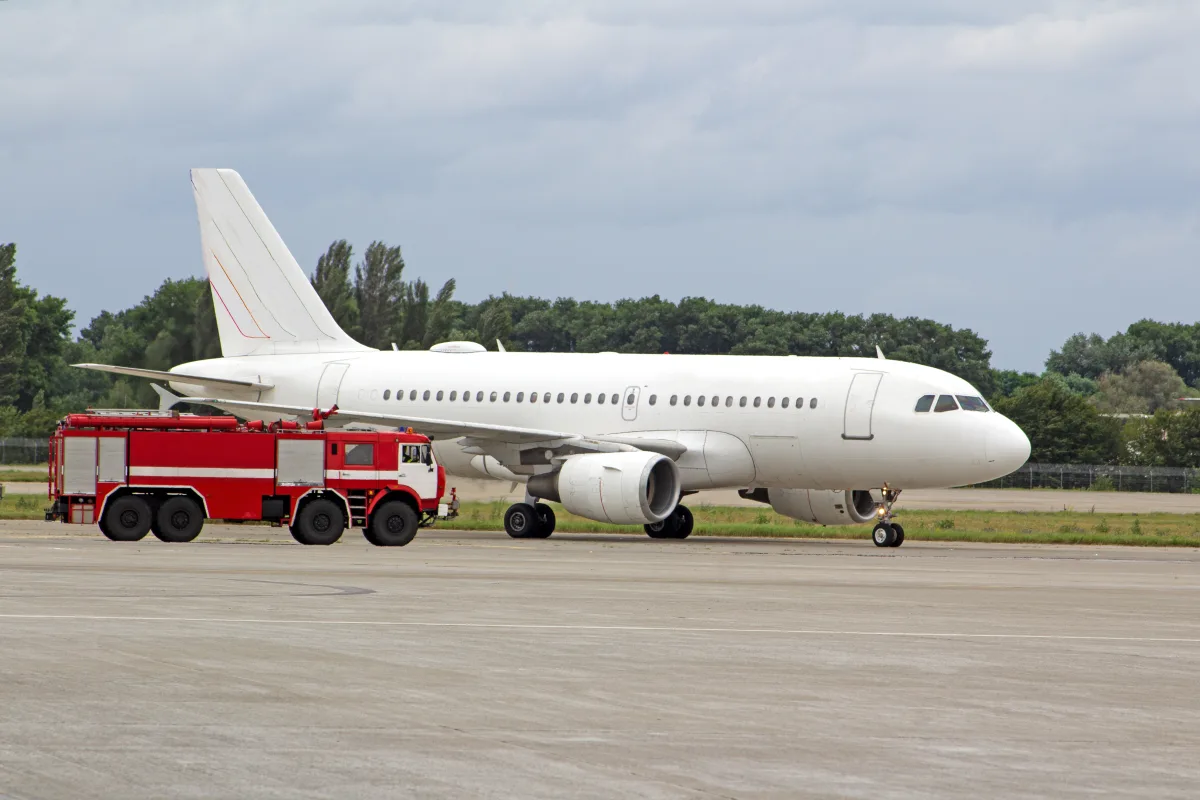
Why 90 seconds is the certification standard, what happens during cabin smoke, why you should keep your shoes on, and real survivor accounts.
The 90-Second Rule — How to Survive an Evacuation
Before a new aircraft type can be certified, it must pass one of the toughest certification requirements in all of aviation: the 90-second evacuation demonstration. All passengers and crew members must be able to exit the aircraft within 90 seconds — in darkness, with half the exits blocked. This standard exists because after 90 seconds, a cabin fire can create lethal conditions. And it works: over 95% of all aircraft accidents in the United States are survivable. But only if the passengers know what to do — and what not to do.
Why exactly 90 seconds?
The 90-second rule goes back to research conducted by the FAA and the UK CAA in the 1960s and 1970s. The investigations showed that during a post-impact cabin fire, the following timeline is typical:
- 0 — 30 seconds: Smoke begins to develop, visibility still present, temperature rises slowly
- 30 — 60 seconds: Smoke thickens, visibility reduced to a few metres (under 10 feet), temperature rises noticeably
- 60 — 90 seconds: Toxic gases reach dangerous concentrations, visibility near zero, temperatures above 140°F (60°C) at head height
- After 90 seconds: Flashover possible — the entire cabin ignites suddenly, survival virtually impossible
This timeline is simplified, of course — every accident is different. But the 90-second threshold has proven to be a reliable benchmark. That is why both the FAA (14 CFR 25.803) and EASA (CS 25.803) require that every commercial aircraft must demonstrate that a complete evacuation is possible within 90 seconds.
The certification test — how it works
The 90-second evacuation demonstration is one of the most spectacular tests in aviation certification. The conditions:
- Full passenger capacity: All seats are occupied — for an A380, that is up to 853 people in the maximum possible configuration
- Only half the exits: Which exits are blocked is not revealed to the participants until the moment of the test
- Emergency lighting only: Only the emergency lighting is active; the main cabin lighting is off
- Mixed passengers: Participants must represent a realistic age distribution — at least 40% women, at least 35% over 50 years old, at least 15% of the women over 50, and at least three dolls representing infants
- No advance briefing: Participants do not know which exits will be opened
- Crew strength: Only the minimum cabin crew is present
The Airbus A380 passed its evacuation demonstration on 26 March 2006 in Hamburg: 853 people exited the aircraft in 78 seconds — 12 seconds under the limit. Nevertheless, 33 people sustained minor injuries, illustrating the intensity of such tests.
The Boeing 777 completed its test in 1995 with 777 passengers and crew members — a symbolic number. The evacuation was completed in 77 seconds.
Emirates Flight EK521 — Dubai, 3 August 2016
A Boeing 777-300 operated by Emirates attempted to land at Dubai International Airport but touched down on the runway following an aborted go-around attempt, causing the landing gear to collapse. The aircraft slid along the runway on its belly and came to a stop. A fire broke out, fuelled by leaking fuel.
On board were 300 passengers and crew members. All survived — except one firefighter who died during the firefighting operations. The evacuation was in many respects a success, but it revealed a massive problem: passengers reached for their carry-on luggage.
Videos from inside the cabin show passengers rummaging through the overhead bins for their bags and suitcases while smoke poured into the cabin and flight attendants screamed desperately: "Leave everything! Leave everything!" One passenger was filmed going down the emergency slide carrying two roller bags.
The investigation by the UAE General Civil Aviation Authority found that the evacuation took significantly longer than necessary because passengers wanted to take their belongings. It was pure luck that all passengers survived. Had the fire spread faster, the seconds lost to luggage retrieval could have cost people their lives.
British Airways Flight BA2276 — Las Vegas, 8 September 2015
A Boeing 777-200 operated by British Airways aborted its takeoff at McCarran International Airport in Las Vegas when the left engine caught fire. The aircraft came to a stop on the runway as flames engulfed the left engine and reached the fuselage.
On board were 170 people. All survived. The cabin crew initiated an evacuation via the right side — away from the fire. Yet here too, passenger videos showed people pushing into the aisle to retrieve their luggage. The NTSB stated in its report that taking carry-on luggage delayed the evacuation and increased the risk for all passengers.
Following this incident, the NTSB recommended a review of regulations concerning carry-on luggage during evacuations and suggested that overhead bins should automatically lock during an evacuation — a recommendation that has not yet been implemented.
Why luggage kills during an evacuation
The physics are simple: every second a passenger spends reaching into the overhead bin blocks the aisle for all passengers behind them. In an aircraft with 200 passengers and a single aisle, a delay of 5 seconds per passenger retrieving luggage translates into a total delay of minutes — minutes that do not exist during a fire.
Furthermore:
- Roller bags on emergency slides: A 26-pound (12 kg) suitcase sliding down an emergency slide becomes a projectile. It can strike the passenger below and cause serious injury — or damage the slide
- Blocked exits: Passengers arriving at the exit with luggage block the passageway. Emergency exits are designed for the rapid flow of people, not people carrying hand luggage
- Sharp edges: Hard-shell suitcases have corners and edges that can damage emergency slides. A damaged slide can deflate and become unusable
The rule is unambiguous: during an evacuation, leave everything behind. Your passport, your phone, your laptop, your bag — everything. Your life and the lives of the people behind you depend on it.
Smoke behaviour in the cabin
In an aircraft cabin, smoke behaves differently than in a building. The cabin is an enclosed tubular cross-section with a small volume. Smoke fills this space extremely rapidly.
Smoke layering follows a predictable pattern:
- Phase 1 (0 — 30 seconds): Smoke rises to the cabin ceiling and forms a visible layer. Below it, the air is still clear
- Phase 2 (30 — 60 seconds): The smoke layer descends. At the head height of a standing adult, visibility is already severely restricted
- Phase 3 (60 — 90 seconds): The smoke reaches seat level. Breathable air remains only directly above the floor
The toxic components of cabin smoke are particularly dangerous. Modern cabin materials — though more fire-resistant than in the past — release the following when burning:
- Carbon monoxide (CO): Colourless and odourless, it blocks oxygen uptake in the blood. Three to four breaths at high concentration lead to unconsciousness
- Hydrogen cyanide (HCN): Produced when plastics and textiles burn. Acts even faster than CO
- Phosgene: Produced when certain plastics burn. Damages the lungs
The survival strategy: stay as low as possible. Crawl on all fours. Breathable air is at the floor. The floor-level emergency lighting guides you to the exit. Hold a cloth — even a piece of clothing — over your mouth and nose, ideally damp.
Why shoes matter
During an evacuation, passengers exit the aircraft via emergency slides onto tarmac, grass, possibly debris, metal, or burning material. Evacuating barefoot or in socks means:
- Cut injuries from metal parts and debris
- Burns from hot tarmac or melted materials
- Inability to move away from the aircraft quickly
The recommendation of experienced safety experts: wear sturdy, closed-toe shoes during takeoff and landing. Most accidents occur during these flight phases. Sandals and high heels are problematic — high heels must be removed before going down the slide, as they can puncture it.
Overwing exits — special requirements
Overwing exits have special requirements. Passengers seated in the rows adjacent to these exits are asked before the flight whether they are willing and able to assist in an emergency. The requirements:
- Physical ability: The person must be able to lift and discard the exit cover (weighing 33 to 55 pounds / 15 to 25 kilograms, depending on type)
- Language skills: The person must be able to understand crew instructions
- Willingness: The person must be prepared to act in an emergency — to open the exit, direct other passengers, step onto the wing if necessary, and point the way to the emergency slides at the trailing edge of the wing
The overwing exit is not a standard exit. It leads onto the wing, which can be slippery (fuel, rain, ice). From there, passengers descend via a slide or a path at the trailing edge of the wing. This route requires more physical ability than a standard exit with a slide.
Crew commands: what they mean
| Command | Meaning | Your response |
|---|---|---|
| "Brace, brace!" | Impact is imminent | Immediately adopt brace position |
| "Evacuate, evacuate!" | Immediate evacuation ordered | Release seatbelt, leave everything, move to nearest exit |
| "Leave everything!" | Do not take any luggage | Let go of everything, head for the exit |
| "Come this way!" | Flight attendant directing to exit | Follow the voice |
| "This exit is blocked!" | Exit not usable | Turn around, go to the next exit |
| "Jump and slide!" | Jump onto the emergency slide | Cross arms over chest, jump, do not sit down and slide cautiously |
When you should evacuate on your own: If there is fire or smoke in the cabin and no crew member is able to give instructions, if there is obvious danger and no instructions are coming, or if the cabin is filling with smoke and no one is initiating the evacuation. In these cases, act on your own: release seatbelt, leave everything behind, go to the nearest exit, open it, and get out.
After the evacuation — do not stand around
The evacuation does not end at the bottom of the emergency slide. After leaving the aircraft:
- Move away from the aircraft immediately: At least 500 feet (150 metres). A fully fuelled commercial aircraft carries tens of thousands of litres of jet fuel. In an explosion, the fireball extends far beyond the aircraft
- Move upwind: If possible, run against the wind or crosswind — away from smoke and fumes
- Do not return: Under no circumstances return to the aircraft to retrieve luggage or personal items
- Go to the assembly point: Emergency services will set up assembly points. Go there and register
- Help others: If you are uninjured, help injured people move away from the aircraft
The statistics: aircraft accidents are survivable
In 2001, the NTSB published a comprehensive study titled "Survivability of Accidents Involving Part 121 U.S. Air Carrier Operations, 1983 Through 2000." The findings disprove the myth that aircraft accidents are automatically fatal:
- 568 accidents involving 53,487 occupants were analysed
- 51,207 people survived — that is 95.7%
- Even in the most severe accidents classified as "major," the survival rate was over 76%
- In accidents involving fire, the survival rate was lower — but still over 60% when evacuation was carried out quickly
These numbers demonstrate: the overwhelming majority of aircraft accidents are survivable. But the survival rate depends critically on how quickly and orderly the evacuation proceeds. And that depends on every single passenger.
Your emergency checklist
- Before the flight: Wear sturdy shoes, read the safety card, count the rows to the nearest exit
- On the "Brace" command: Immediately adopt the brace position — head down, hands over head or against the seat in front
- After the aircraft stops: Open seatbelt (lift the metal plate!), leave everything behind, move to the nearest functioning exit
- In smoke: Stay low, count rows tactilely, follow the floor-level lighting
- At the slide: Arms across chest, jump, do not sit down and slide cautiously
- Outside: Immediately move at least 500 feet (150 metres) away from the aircraft, do not return
Conclusion: 90 seconds decide everything
The 90-second rule is not an abstraction. It is the hard boundary between survival and death in a cabin fire. Every second lost to luggage retrieval, disorientation, or hesitation is missing at the end — not just for you, but for every passenger behind you in the aisle. The difference between the passengers who all survived Emirates 521 and those who did not survive earlier accidents was often not luck — it was the speed of the evacuation. And speed comes from preparation. Read the safety card. Count the rows. Leave everything behind. Get out. Move away. Live.
Safety First
Flying is the safest mode of transport in the world — thanks to decades of experience, cutting-edge technology and the strictest regulations. Knowledge builds trust: The more you understand about aviation safety, the more relaxed you fly.
