
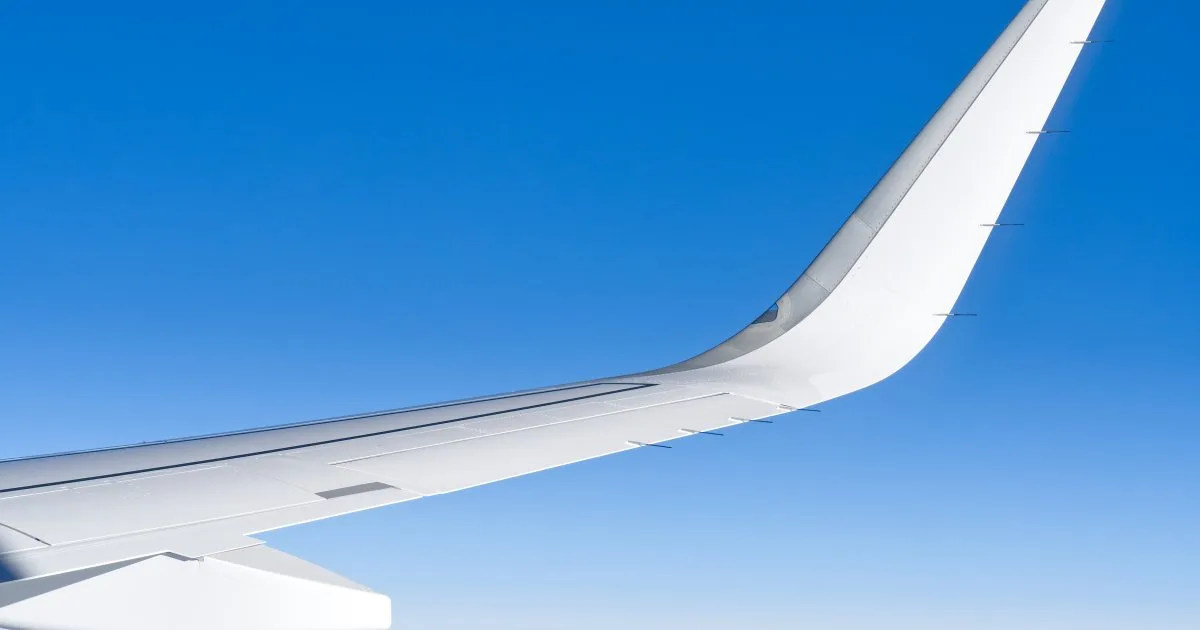
The four forces acting on an aircraft: How lift is generated, what drag means, and why the balance between thrust and weight determines flight.
The Four Forces of Flight -- Aerodynamics for Aspiring Pilots
Every aircraft in flight is subject to the interplay of four fundamental forces: lift, weight, thrust, and drag. Understanding these forces and their interactions is not an academic luxury -- it is the foundation of safe flying. A pilot who understands why a wing produces lift and when it will stop doing so makes better decisions in the cockpit.
The Four Fundamental Forces
In steady, unaccelerated straight-and-level flight, the four forces are in equilibrium:
- Lift (L): Acts perpendicular to the relative wind, generated by the wings, directed upward
- Weight (W): Acts vertically downward toward the center of the earth, caused by the mass of the aircraft and gravity
- Thrust (T): Acts in the direction of flight, generated by the engine and propeller
- Drag (D): Acts opposite to the direction of flight, caused by air friction and airflow disruption
In equilibrium: L = W and T = D. Any deviation from this equilibrium results in acceleration -- the aircraft climbs, descends, speeds up, or slows down.
Lift -- Why a Wing Flies
Lift generation can be explained through two complementary physical models. Neither is complete on its own, but together they provide a coherent picture:
Bernoulli's explanation: The airfoil shape of a wing causes the air flowing over the upper surface (suction side) to accelerate relative to the lower surface (pressure side). According to Bernoulli's principle, as flow velocity increases, static pressure decreases. The resulting pressure differential between upper and lower surfaces produces a force perpendicular to the airflow -- lift. Approximately two-thirds of the lift is generated by the low pressure on the upper surface; only one-third comes from the higher pressure below.
Newton's explanation: The wing deflects the airstream downward (downwash). According to Newton's third law (for every action, there is an equal and opposite reaction), this downward deflection of air mass produces an equal upward force -- lift. The greater the angle of attack and the stronger the deflection, the greater the lift -- up to a critical point.
The Lift Equation
Lift can be expressed mathematically:
L = CL × ½ × ρ × V² × S
The individual factors:
| Symbol | Name | Influencing Factors |
|---|---|---|
| CL | Coefficient of lift | Depends on airfoil shape, angle of attack, and flap setting. Dimensionless. |
| ρ (rho) | Air density | Depends on altitude, temperature, and humidity. Decreases with altitude. |
| V | True airspeed (TAS) | Enters the equation squared -- double the speed yields four times the lift. |
| S | Wing area | A design constant, unchangeable in flight (except with Fowler flaps). |
This equation has important practical consequences: since lift varies with the square of the airspeed, halving the speed reduces lift to one-quarter. At constant weight, the aircraft must then increase the coefficient of lift (by increasing the angle of attack) to remain airborne -- until the stall.
Angle of Attack -- The Central Control Variable
The angle of attack (AoA or alpha) is the angle between the chord line of the wing and the relative wind. It is not the same as pitch attitude, although the two are related.
The lift coefficient CL increases approximately linearly with angle of attack -- until the critical angle of attack is reached. For most airfoil profiles, this lies between 15 and 18 degrees. Beyond this angle, the airflow separates from the upper surface of the wing: the aircraft stalls.
The Stall -- Understanding Aerodynamic Stall
A stall occurs when the critical angle of attack is exceeded. The key concept: A stall depends on angle of attack, not airspeed. There is, of course, a "stall speed" (VS), but this refers to the 1g straight-and-level flight condition at a specific configuration and weight. In a steep turn or during an abrupt pull-up maneuver, a stall can occur at significantly higher airspeeds.
The symptoms of an approaching stall:
- Reduced control effectiveness: The controls feel "mushy"
- Buffeting: Vibrations from turbulent airflow over the tail surfaces
- Stall warning: Horn or light (on equipped aircraft)
- Increasing sink rate despite continued back pressure on the control column
- Nose drops (in well-behaved aircraft designs)
Stall recovery is fundamentally straightforward: reduce the angle of attack (push forward on the yoke/stick) and apply power. The sequence matters -- angle of attack first, then power. Near the ground, a stall can be fatal because there is insufficient altitude for recovery.
Drag -- The Braking Force
The total drag of an aircraft is composed of several components:
Parasite drag: Caused by the shape of the aircraft (form drag), surface friction (skin friction drag), and interference effects from antennas, landing gear, rivets, and protrusions (interference drag). Parasite drag increases with the square of the airspeed -- doubling the speed produces four times the parasite drag.
Induced drag: A direct consequence of lift production. At the wingtips, air flows from the high-pressure side (below) to the low-pressure side (above), creating wingtip vortices (wake turbulence). These vortices alter the effective angle of the relative wind, tilting the lift vector slightly rearward -- the rearward component is induced drag. It is inversely proportional to the square of the airspeed: induced drag is highest at low speeds.
The sum of both drag components produces the characteristic total drag curve: induced drag dominates at low speeds, parasite drag at high speeds. Between them lies a minimum -- the speed of minimum total drag. This speed is identical to the best glide speed (VBG) and the speed for maximum range.
The Drag Polar
The drag polar (also known as the Lilienthal polar) is a graphical representation of the relationship between the lift coefficient CL and drag coefficient CD. It is the central tool of aerodynamics:
- The Y-axis shows the lift coefficient CL
- The X-axis shows the drag coefficient CD
- The curve starts at low angles of attack (low lift, low drag) and rises with increasing AoA
- The highest point of the curve marks CL,max -- the maximum lift coefficient just before the stall
- A tangent line from the origin to the polar touches it at the point of maximum L/D ratio (best glide performance)
Extending flaps shifts the polar upward and to the right: more lift, but also more drag. For takeoff, this means a shorter ground roll (higher CL at lower speed); for landing, a steeper approach angle at reduced speed.
Thrust and Power
Thrust is the force produced by the propeller as it accelerates a mass of air. In piston-engine aircraft, it is important to distinguish between thrust (force in pounds or Newtons) and power (work per unit time in horsepower or watts):
- Available thrust decreases with airspeed: a propeller is most efficient at rest (static thrust) and loses efficiency with increasing flight speed
- Available power (P = T x V) initially increases with airspeed, then decreases
- Required power follows the drag curve: minimum at the speed of minimum drag, rising steeply on either side
The excess power (available minus required) determines the aircraft's climb capability. At the speed of maximum excess power, the aircraft achieves the best rate of climb (VY). The best angle of climb speed (VX) is found at the speed of maximum excess thrust and is typically lower than VY.
Weight and Balance
Weight fundamentally affects aircraft performance:
- Higher weight = higher stall speed: VS increases proportionally to the square root of the weight increase. A 10% weight increase means approximately 5% higher VS.
- Higher weight = reduced climb performance: Excess power decreases
- Higher weight = higher fuel consumption: More drag at the same CL
- Higher weight = longer takeoff distance: Higher VR (rotation speed), more energy required
The center of gravity (CG) must remain within the allowable range. A forward CG increases stability but also increases drag from the greater trim requirement. An aft CG reduces longitudinal stability to the point of uncontrollability. The weight-and-balance calculation before every flight is not a formality -- it is a safety-critical obligation.
Load Factor -- The G-Force
The load factor (n) describes the ratio of lift acting on the aircraft to its weight:
n = L / W
In straight, unaccelerated flight, n = 1 (1g). In a bank, lift must overcome both the vertical weight component and provide centripetal force, resulting in higher load factors:
| Bank Angle | Load Factor (n) | Stall Speed Factor | Practical Significance |
|---|---|---|---|
| 0 degrees (straight) | 1.0 | 1.00 | Normal flight |
| 30 degrees | 1.15 | 1.07 | Normal cruising turn |
| 45 degrees | 1.41 | 1.19 | Steep turn (PPL checkride maneuver) |
| 60 degrees | 2.00 | 1.41 | Stall speed increases by 41% |
| 75 degrees | 3.86 | 1.97 | Near structural load limits |
The stall speed increases with the square root of the load factor: VS,n = VS1g × √n. In a 60-degree banked turn, the stall speed is 41% higher than in straight-and-level flight. This fact has contributed to numerous fatal accidents, particularly during tight turns on final approach (stall-spin accidents during turnback attempts after engine failure on departure).
Every aircraft has certified load factor limits specified in the Pilot's Operating Handbook (POH):
- Normal Category: +3.8g / -1.52g
- Utility Category: +4.4g / -1.76g
- Aerobatic Category: +6.0g / -3.0g
V-Speeds -- Essential Performance Numbers
Every aircraft has defined speeds specified in the POH (Pilot's Operating Handbook) or AFM (Aircraft Flight Manual). The most important ones for PPL pilots:
| V-Speed | Name | Definition |
|---|---|---|
| VS0 | Stall speed (landing configuration) | Lowest stall speed with flaps and gear extended |
| VS1 | Stall speed (clean) | Stall speed in clean configuration |
| VR | Rotation speed | Speed to rotate (raise the nose) during takeoff |
| VX | Best angle of climb speed | Steepest climb angle -- used for obstacle clearance after takeoff |
| VY | Best rate of climb speed | Greatest climb rate (ft/min) -- used for fastest altitude gain |
| VA | Maneuvering speed | Maximum speed for full control deflection without structural damage |
| VFE | Maximum flap extended speed | Maximum speed with flaps deployed |
| VNO | Maximum structural cruising speed | Maximum speed in smooth air only |
| VNE | Never exceed speed | Must never be exceeded -- structural failure is possible |
| VBG | Best glide speed | Maximum glide range following engine failure |
V-speeds are color-coded on the airspeed indicator: the white arc shows the flap operating range (VS0 to VFE), the green arc shows the normal operating range (VS1 to VNO), the yellow arc shows the caution range (VNO to VNE, smooth air only), and the red line marks VNE.
Density Altitude -- The Invisible Performance Killer
Density altitude describes the altitude in the standard atmosphere that corresponds to the current air density. On a hot summer day at a high-elevation airport, the density altitude can be several thousand feet above the actual field elevation.
High density altitude means:
- Reduced lift (thinner air, fewer molecules per unit volume)
- Reduced thrust (propeller moves less air mass)
- Reduced engine power (less oxygen for combustion)
- Higher true airspeed (TAS) at the same indicated airspeed (IAS)
- Longer takeoff and landing distances
- Reduced rate of climb
Rule of thumb: For every 1,000 ft of density altitude, takeoff distance increases by approximately 10% and climb rate decreases by approximately 10%. An aircraft that requires 1,500 ft of runway at sea level may need over 2,500 ft at a mountain airstrip at 5,000 ft elevation on a hot day -- and that is before factoring in runway slope and wind.
Understanding aerodynamics is not a one-time lesson to be checked off after the knowledge exam. It is a living tool that accompanies every preflight briefing, every takeoff, every turn, and every landing. A pilot who understands the physics of flight recognizes hazards earlier and acts more safely.
