
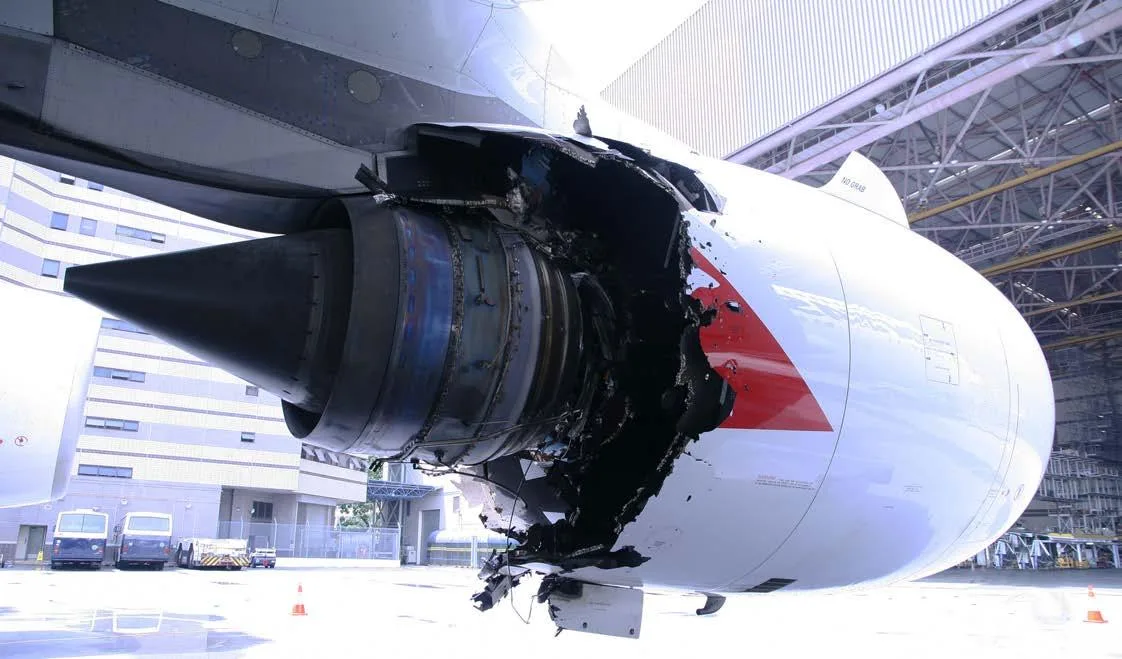
A380, uncontained engine failure over Singapore: 2 hours of checklists, 5 pilots in the cockpit, and all 469 passengers survived.
Qantas Flight 32 — Engine Explosion Over Singapore
On November 4, 2010, engine number 2 of an Airbus A380 operated by Australian airline Qantas exploded shortly after takeoff from Changi Airport in Singapore. The uncontained engine failure caused massive damage to the wing, fuel system, hydraulics, and flight controls. On board were 440 passengers, 24 cabin crew members, and five pilots in the cockpit. All 469 people on board survived. What could have ended as an inevitable crash was prevented by extraordinary Crew Resource Management, the redundancy of the A380, and the determination of an experienced crew.
The Flight and the Unusual Cockpit Crew
Qantas Flight 32 (QF32) was a scheduled service from Singapore to Sydney. The aircraft, an Airbus A380-842 with registration VH-OQA and the name "Nancy-Bird Walton," was only 26 months old at the time.
On that day, five pilots were in the cockpit — unusual for a routine flight. The reason: it was partly a check flight.
- Captain Richard de Crespigny — Pilot in Command, over 15,000 flight hours, former Royal Australian Air Force pilot.
- First Officer Matt Hicks — Copilot who was flying the aircraft at takeoff.
- Second Officer Mark Johnson — Designated for relief duties on the long-haul segment.
- Supervising Check Captain David Evans — An instructor who was conducting the check ride for the fifth pilot.
- First Officer Harry Wubben — The pilot undergoing his check ride that day.
What might initially seem like a disadvantage — five pilots who could potentially get in each other's way — proved to be one of the decisive factors in the survival of everyone on board.
9:01 AM Local Time — The Explosion
Four minutes after takeoff from Runway 20C at Changi, at an altitude of approximately 7,400 feet and over the Indonesian island of Batam, the catastrophe occurred. A disc from the intermediate pressure turbine of the Rolls-Royce Trent 900 engine number 2 (the inner left engine) fractured due to a fatigue crack in an oil feed pipe and the resulting oil combustion.
The failure was uncontained — meaning that engine parts breached the engine casing, which normally serves as a protective shield. Heavy metal fragments, some as large as car doors, were hurled outward at tremendous velocity.
The Extent of the Damage
The shrapnel from the exploded turbine disc inflicted catastrophic damage to the left wing and fuselage of the A380. The subsequent investigation by the Australian Transport Safety Bureau (ATSB) documented over 650 individual instances of damage:
| System | Damage | Effect |
|---|---|---|
| Left wing | Large holes in leading and trailing edges, structural damage | Reduced aerodynamics, fuel leakage |
| Fuel system | Fuel lines severed, tanks damaged | Massive fuel loss, fire hazard, center of gravity shift |
| Hydraulic system | Green hydraulic system completely failed, yellow partially | Limited flight controls, reduced braking capability |
| Flight controls | Multiple slats and flaps on the left side jammed or severed | Asymmetric lift distribution, higher landing speed |
| Electrical system | Cables severed, generators partially failed | Reduced electrical power supply |
| Landing gear | Anti-skid system partially failed | Increased risk during post-landing braking |
| Engine 1 | Damaged but operational with limitations | Could only provide limited thrust |
| Wiring | Over 400 cables severed | Systems failed or provided erroneous data |
A piece of the turbine disc struck through a lower fuselage panel and narrowly missed the main landing gear bay. On the Indonesian island of Batam, debris fell on inhabited areas — by pure luck, no one on the ground was injured.
54 ECAM Messages and Two Hours of Crisis Management
The Electronic Centralized Aircraft Monitor (ECAM) of the A380 immediately began displaying fault messages and checklists after the explosion. In the following minutes, 54 different ECAM messages were generated — more than any crew had ever seen in a simulator. Many of these messages were contradictory or incomprehensible because the sensors themselves were damaged and delivering false data.
Captain de Crespigny immediately made a critical decision regarding cockpit task distribution:
- De Crespigny: Assumed overall command, flew the aircraft, and made all critical decisions.
- First Officer Hicks: Worked through the ECAM checklists, prioritized messages.
- Check Captain Evans: Monitored the ECAM processing, served as quality control.
- Second Officer Johnson and First Officer Wubben: Performed calculations, verified systems, gathered information.
Processing the ECAM checklists took nearly two hours. During this time, the severely damaged A380 circled over the South China Sea and the Strait of Singapore. The pilots had to evaluate each message, decide whether the suggested action was safe, and simultaneously maintain awareness of the aircraft's overall condition.
De Crespigny later described his mental approach: rather than focusing on what was no longer working — which would have been overwhelming — he directed his focus to what still functioned. He mentally treated the heavily damaged A380 like the simplest aircraft he knew: a single-engine Cessna. Aviate, navigate, communicate — the fundamentals.
The Landing — On a Knife's Edge
After nearly two hours in the air, the crew prepared for landing on Runway 20C at Changi. The situation was extremely complex:
- Increased landing speed: Due to damaged and jammed slats and flaps, the landing speed had to be significantly higher than normal — approximately 166 knots instead of the usual 140 knots.
- Overweight: The aircraft was well above maximum landing weight, as the fuel jettison system was also damaged and only partially functional.
- Limited braking: Anti-skid system partially failed, only limited braking capacity available.
- Asymmetric thrust: Engine 1 (outer left) was damaged and providing limited thrust, engine 2 was destroyed — only the two right engines (3 and 4) were fully functional.
- No thrust reversal: Thrust reversal was operational on engine 3 only — one of four engines.
De Crespigny set the A380 down precisely on the runway. The aircraft rolled out at high speed and came to a stop just 150 meters (490 feet) from the runway end. The brakes heated to such an extent that several tires burst and the brakes began to glow.
But the crisis was not yet over. Fuel leaked from the damaged left wing onto the glowing brakes. Changi Airport's fire service responded immediately and continuously cooled the brakes with fire-retardant foam. Engine number 1, whose controls were also damaged, could not be shut down and continued running for over two hours after landing until it was finally smothered with extinguishing agent.
The Evacuation
Captain de Crespigny deliberately chose against an immediate emergency slide evacuation. His reasoning: with 440 passengers and glowing brakes, leaking fuel, and an engine that could not be shut down, a controlled evacuation via mobile stairs was safer than a panicked slide evacuation, where passengers would have landed directly adjacent to burning brakes and leaking jet fuel. This unconventional decision was controversial but proved correct. All 469 people on board exited the aircraft uninjured via mobile stairs.
The Investigation — A Faulty Oil Pipe
The ATSB investigation lasted over three years. The final report of 2013 identified the cause as a fatigue crack in an oil feed stub pipe within the Trent 900 engine. The pipe had been manufactured with a thinner wall thickness than specified. During operation, oil seeped through the crack, ignited on hot engine components, and caused an internal fire that ultimately led to failure of the intermediate pressure turbine disc.
Rolls-Royce accepted responsibility and initiated a comprehensive inspection and redesign program:
- All Trent 900 engines worldwide were inspected.
- The affected oil pipes were replaced with improved versions.
- Manufacturing controls were tightened.
- Rolls-Royce paid Qantas compensation of USD 95 million.
CRM as the Gold Standard
Qantas Flight 32 is taught in pilot training programs worldwide as a textbook example of effective CRM. The decisive factors were:
- Clear hierarchy with simultaneous openness: De Crespigny was the undisputed decision-maker, but he listened to the objections and suggestions of his colleagues. When Check Captain Evans questioned one of his decisions, de Crespigny took the time to explain his reasoning — in the midst of the crisis.
- Task distribution: Distributing the workload across five pilots prevented cognitive overload on any single crew member. Without the additional pilots, managing the 54 ECAM messages while simultaneously flying the aircraft would have been nearly impossible.
- Focus on the essentials: De Crespigny's approach of concentrating on what was working rather than what was broken prevented paralysis from the sheer volume of problems.
- Situational awareness: Despite the chaos, the crew maintained constant awareness of the aircraft's overall condition, remaining options, and available resources.
Why the A380 Survived the Incident
The Airbus A380 is designed with quadruple redundancy in its critical systems. It features three independent hydraulic circuits, multiple electrical systems, and four engines. Despite the massive damage, sufficient systems remained functional to keep the aircraft controllable and landable. This level of redundancy meets and exceeds the requirements set by both EASA (CS-25) and FAA (14 CFR Part 25) for large transport category aircraft.
De Crespigny later remarked: "The A380 is the only aircraft I know that could have survived this damage." Whether this statement holds true in absolute terms is debatable — but there is no question that Airbus's redundancy philosophy emphatically proved its merit on that day.
Lessons and Legacy
Qantas Flight 32 left a lasting mark on aviation:
- Engine certification: Standards for engine failure containment were reviewed and tightened by both EASA and the FAA, ensuring that uncontained disc failures are addressed through improved manufacturing and inspection protocols.
- ECAM design: Airbus revised the prioritization and presentation of ECAM messages to better support crews in multiple-failure scenarios.
- CRM training: The incident was integrated into CRM training programs worldwide as an example of how a large crew can work together effectively.
- Manufacturing quality: The aviation industry tightened supply chain controls and manufacturing tolerances for safety-critical components.
Captain Richard de Crespigny published his book "QF32" in 2012, recounting the incident from his perspective. It became an international bestseller. He was honored with numerous awards, including the Flight Safety Foundation Professionalism Award.
The incident vividly demonstrates that even when damage far exceeds an aircraft's design limits, the combination of robust engineering, professional training, and effective teamwork can make the critical difference. The 469 people on board QF32 owe their lives not to a single hero, but to a system — a system of technology, training, and human excellence that functioned under extreme pressure.
Safety First
Flying is the safest mode of transport in the world — thanks to decades of experience, cutting-edge technology and the strictest regulations. Knowledge builds trust: The more you understand about aviation safety, the more relaxed you fly.
