
From compression to thrust: The thermodynamics of a jet engine explained without an engineering degree but with all relevant details.
How a Jet Engine Really Works — The Physics Explained
Jet engines are among the most fascinating machines ever created. They convert jet fuel and air into tremendous thrust, propelling aircraft weighing hundreds of tons to altitudes above 33,000 feet. But how does a jet engine actually work? In this article, we explain the underlying physics, the thermodynamic cycle, and the key components — in accessible yet technically precise terms.
The Fundamental Principle: Newton's Third Law
The operating principle of a jet engine is rooted in one of the most fundamental laws of physics: Newton's Third Law of Motion, the principle of action and reaction. It states: For every action, there is an equal and opposite reaction.
A jet engine ingests air, compresses it, mixes it with fuel, ignites the mixture, and expels the hot gases rearward at tremendous velocity. The reaction force of this gas expulsion propels the engine — and therefore the aircraft — forward. The greater the mass flow ejected per unit time, and the higher its exit velocity, the greater the thrust produced.
The basic thrust equation is:
F = ṁ × (v_e − v_0)
Where F is thrust, ṁ is mass flow rate (kg/s), v_e is the exhaust gas velocity, and v_0 is the flight velocity.
In practice, turbofan engines also generate thrust from the bypass airstream that flows around the core without passing through it. In modern high-bypass turbofans, this bypass stream produces the majority of the thrust — sometimes over 80 percent.
The Brayton Cycle: The Thermodynamic Heart of the Engine
The energy conversion inside a jet engine follows the Brayton Cycle (also known as the Joule Cycle). This open gas turbine cycle consists of four idealized steps that occur continuously and simultaneously in different sections of the engine:
Phase 1: Intake
The air inlet (intake) is far more than just an opening. Its job is to deliver incoming air to the compressor evenly and with minimal pressure loss. On subsonic aircraft, the inlet is typically designed as a pitot intake — a simple, round opening with a slight divergence.
At high subsonic speeds (Mach 0.8–0.9), the air is decelerated to subsonic velocity within the inlet, producing an initial pressure rise through the ram effect. This ram pressure effect increases with speed and at Mach 0.85 can already deliver a pressure rise of approximately 1.6:1 relative to the ambient static pressure.
Phase 2: Compression
The compressor is the most mechanically demanding component of the engine. Its task: to compress the ingested air to many times its original pressure. Modern engines achieve overall pressure ratios from 30:1 to over 60:1.
In aviation, axial compressors are used almost exclusively. These consist of multiple stages, each comprising a row of rotating blades (rotor) and a row of stationary blades (stator). Each individual stage typically increases pressure by a factor of 1.2 to 1.4. To achieve an overall pressure ratio of, say, 40:1, ten to twenty compressor stages are arranged in series.
The compressor blades become progressively smaller from front to rear as the air volume decreases through compression. The blade geometry is highly complex: each blade is a miniaturized airfoil that redirects the airflow, converting kinetic energy into pressure energy.
| Compressor Type | Pressure Ratio per Stage | Typical Application |
|---|---|---|
| Axial Compressor | 1.2 to 1.4 per stage | All modern jet engines |
| Centrifugal Compressor | 4:1 to 6:1 per stage | Small turboprops, APUs, older jets |
| Axial-Centrifugal Combination | Variable | Pratt & Whitney PT6, Honeywell TFE731 |
A critical phenomenon in the compressor is the compressor stall. When the angle of attack of the air on the compressor blades becomes too steep — due to rapid power changes or disturbed inlet flow — the airflow separates from the blades. This manifests as loud banging noises, vibrations, and potentially flames at the inlet. Modern engines use Variable Stator Vanes (VSV) and Bleed Valves to keep the compressor stable across all operating conditions.
Phase 3: Combustion
In the combustion chamber, energy is added to the compressed airflow. Jet fuel (Jet-A1) is sprayed into the combustor through finely atomizing injector nozzles and ignited. Temperatures in the primary combustion zone reach 2,700 to 3,600 degrees Fahrenheit — hotter than the melting point of most metals from which the combustor and downstream turbine are made.
This paradox is resolved through several measures: First, only a fraction of the air (approximately 25 percent) actually participates in combustion. The remainder is channeled as cooling air around the combustor walls and mixed in downstream to reduce the gas temperature to a level the turbine can tolerate — approximately 2,200 to 3,100 degrees Fahrenheit. Second, the turbine blades are protected by intricate internal cooling passages and ceramic Thermal Barrier Coatings (TBC).
Modern combustion chambers are designed as annular combustors. Compared to older can-type combustors, these provide a more uniform temperature distribution, lower pressure loss, and better emissions performance. The pressure loss across the combustor is typically only 3 to 5 percent of the total pressure.
Phase 4: Expansion — Turbine and Nozzle
The hot, high-energy gases flow from the combustion chamber into the turbine. The turbine is the counterpart to the compressor: while the compressor adds energy to the airflow, the turbine extracts energy from it. This energy is transmitted via a shaft to drive the compressor (and in turbofans, the fan as well).
Turbine blades endure the most extreme conditions in the entire engine: temperatures exceeding 2,200 degrees Fahrenheit combined with centrifugal loads of several tons per blade. Each individual high-pressure turbine blade in a large engine produces power equivalent to that of a Formula 1 engine.
The turbine extracts approximately 60 to 70 percent of the gas stream's energy to drive the compressor and fan. The remaining energy is converted into kinetic energy — velocity — in the exhaust nozzle. The gases leave the nozzle at velocities of 1,600 to over 2,300 feet per second.
N1 and N2: The Two Spools of a Turbofan Engine
Modern turbofan engines are built as twin-spool engines. This means there are two independent rotating systems arranged coaxially (one inside the other):
- N1 (Low-Pressure Spool): Comprises the fan, the Low-Pressure Compressor (LPC), and the Low-Pressure Turbine (LPT). The N1 spool typically rotates at 2,000 to 4,000 RPM. N1 speed is the primary indicator of thrust output and is displayed in the cockpit as a percentage.
- N2 (High-Pressure Spool): Comprises the High-Pressure Compressor (HPC) and the High-Pressure Turbine (HPT). The N2 spool rotates considerably faster, typically at 10,000 to 15,000 RPM in large engines and even faster in smaller ones.
Some engines — particularly those by Rolls-Royce (the Trent family) — use three spools (N1, N2, N3). This allows each compressor and turbine section to operate at its optimal speed, increasing overall efficiency.
Pratt & Whitney takes a different approach with the GTF (Geared Turbofan) engines: a reduction gearbox between the fan and the low-pressure turbine allows the fan to turn slowly while the turbine spins fast. This permits a larger fan diameter without the blade tips reaching supersonic speeds.
FADEC: The Electronic Brain of the Engine
Modern jet engines are controlled by a FADEC (Full Authority Digital Engine Control). This system is the electronic mastermind behind all engine operations. FADEC handles the following tasks:
- Real-time fuel flow regulation
- Monitoring of all engine parameters (temperatures, pressures, spool speeds, vibrations)
- Control of variable stator vanes and bleed valves
- Protection against over-temperature, over-speed, and compressor stall
- Fuel consumption optimization across all operating conditions
- Management of the engine start sequence
FADEC is always dual-redundant: two fully independent channels (Channel A and Channel B) can each control the engine alone. If one channel fails, the other takes over seamlessly. A complete FADEC failure is therefore extremely unlikely.
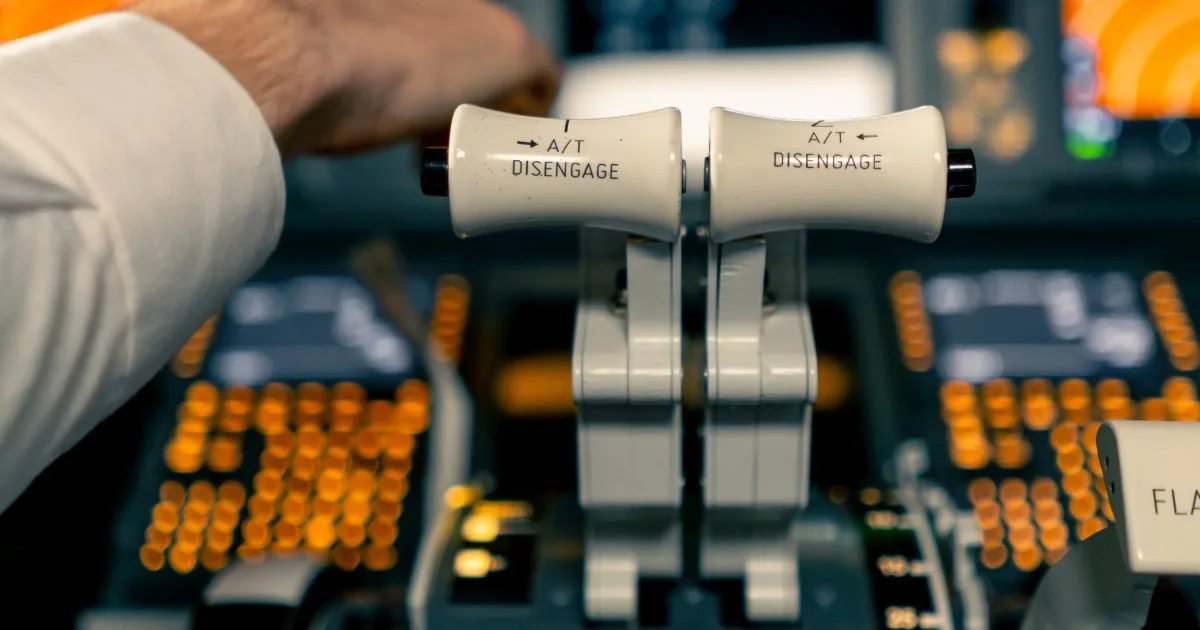
The pilot does not control the engine directly but merely inputs a thrust demand via the thrust lever. FADEC calculates the optimal fuel quantity based on altitude, outside air temperature, Mach number, bleed air extraction, and numerous other parameters. This type of control is known as Full Authority — the system has complete control with no mechanical backup.
The Jet Engine Start Sequence
Starting a jet engine is a precisely choreographed procedure that typically takes 30 to 60 seconds:
- Step 1: The starter (pneumatic via bleed air or electric) rotates the high-pressure spool (N2). Small business jets often use an electric starter, while large airliners use compressed air from the APU (Auxiliary Power Unit) or a ground start unit.
- Step 2: At approximately 20–25 percent N2, fuel flow is initiated and the igniters are activated.
- Step 3: Combustion begins — indicated by a rise in Exhaust Gas Temperature (EGT). FADEC closely monitors the EGT rise to prevent a hot start, where the temperature would exceed allowable limits.
- Step 4: The engine accelerates on its own. At approximately 50–60 percent N2, the turbine generates enough power to drive the compressor independently — the starter is disengaged.
- Step 5: The engine reaches idle at typically 55–65 percent N1 and stabilizes.
Fan Blade Materials: From Titanium to CFRP
The fan blades of a modern turbofan engine are highly stressed components. At full speed, each individual blade experiences centrifugal forces of approximately 130,000 to 175,000 pounds. At the same time, the blades must withstand bird strikes — during certification tests, a four-pound bird is fired into the running engine at takeoff power.
Traditionally, fan blades have been manufactured from titanium alloys. Titanium offers an excellent strength-to-weight ratio and is corrosion-resistant. The blades are fabricated as hollow structures (Hollow Titanium Blades) to save weight — a technology that Rolls-Royce perfected for the Trent series.
The current trend, however, is toward CFRP fan blades (Carbon Fiber Reinforced Polymer). GE Aviation pioneered CFRP fan blades in a large engine with the GE90 in the 1990s. Each CFRP blade is built up from thousands of individual carbon fiber layers embedded in epoxy resin. The blades of the GE9X — the world's largest turbofan engine — consist of 16 CFRP fan blades and are lighter than their titanium equivalents.
CFM International uses an innovative 3D woven CFRP process (RTM — Resin Transfer Moulding) for the LEAP engine. Three-dimensionally woven carbon fiber structures are infused with resin. The result: fan blades that are about one pound lighter than conventional titanium blades while exhibiting greater damage tolerance. The leading edge is fitted with a titanium sheath for protection against erosion and bird strikes.
Performance Metrics and Efficiency
Jet engine efficiency is typically expressed using TSFC (Thrust Specific Fuel Consumption). It indicates how much fuel is consumed per unit of thrust per hour — measured in lb/(lbf·h) or g/(kN·s).
| Engine Type | Typical TSFC | Example Engine |
|---|---|---|
| Turbojet | 0.8 – 1.1 lb/(lbf·h) | J85, Olympus 593 |
| Low-Bypass Turbofan | 0.6 – 0.8 lb/(lbf·h) | CFM56, CF34 |
| High-Bypass Turbofan | 0.5 – 0.6 lb/(lbf·h) | CFM LEAP, PW GTF, GE9X |
The thermal efficiency of modern turbofan engines is approximately 50 to 55 percent, with a propulsive efficiency of 70 to 80 percent. The overall efficiency — the product of both — reaches values of 35 to 43 percent. While this may sound modest, it is remarkable for a heat engine and significantly better than automotive gasoline engines.
Challenges and Future Technologies
The greatest challenges for the next generation of jet engines are reducing emissions and noise. The European Clean Sky initiative and NASA's CLEEN (Continuous Lower Energy, Emissions, and Noise) program are driving development forward.
Among the most promising technologies are:
- Ceramic Matrix Composites (CMC): These enable higher combustor and turbine temperatures, which increases thermal efficiency. GE already uses CMC components in the LEAP engine.
- Adaptive Engines: Variable bypass ratios that adapt to the current flight condition. The U.S. military AETP (Adaptive Engine Transition Program) is advancing this technology.
- Open Rotor Concepts: CFM International is developing an open-fan engine through the RISE program (Revolutionary Innovation for Sustainable Engines), targeting a 20 percent fuel burn reduction compared to the LEAP.
- Hybrid-Electric Propulsion: Electric motors assist the engine during certain flight phases or power separate fans. Airbus and Rolls-Royce are actively researching such concepts.
Conclusion
A jet engine is a masterpiece of engineering, built on simple physical principles yet achieving extraordinary complexity in its execution. The Brayton Cycle — intake, compression, combustion, expansion — forms the foundation. The challenge lies in the extremes: temperatures that melt metals, rotational speeds generating enormous centrifugal forces, and pressures demanding precision down to the micrometer. That modern engines achieve reliability rates exceeding 99.99 percent and time between overhauls of 20,000 to 40,000 flight hours is an impressive achievement that makes every flight possible.
