
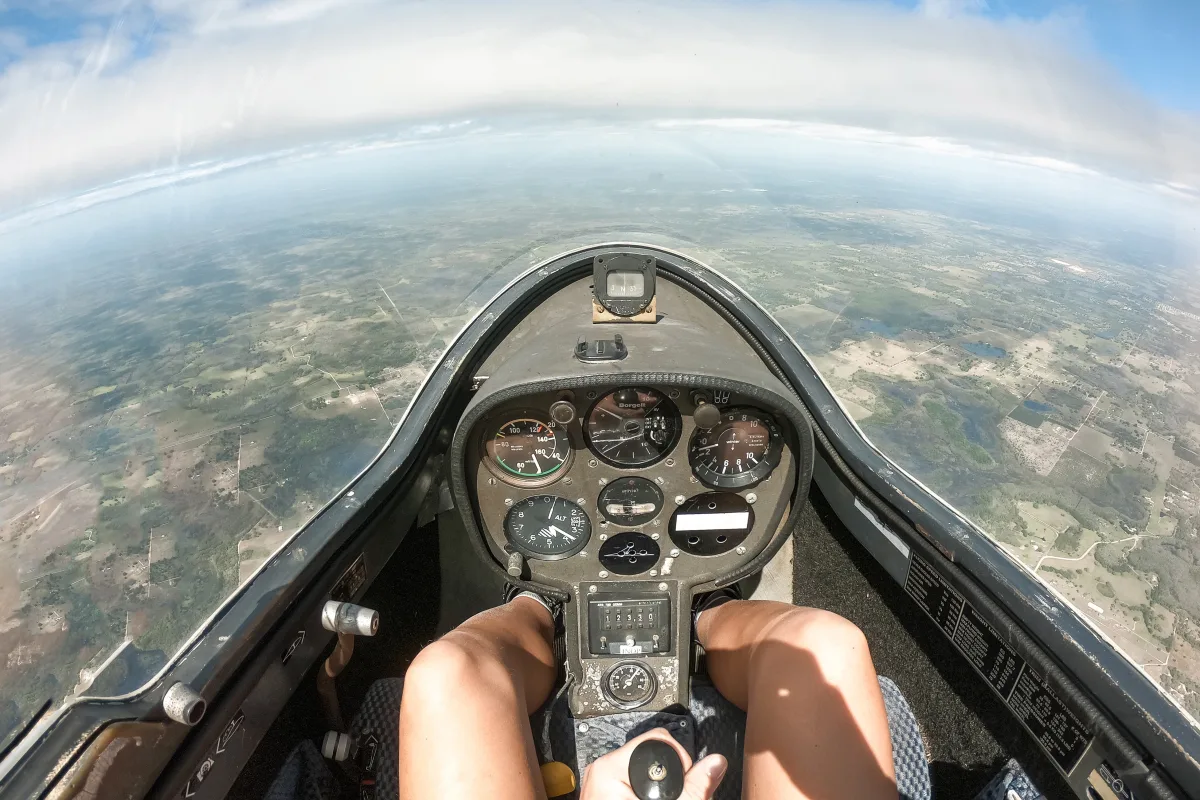
Cross-country tactics: Thermal strategy, final glide calculators, competitions, and why record flights exceed 1,800 miles.
Cross-Country Soaring — How Pilots Fly Hundreds of Miles Without an Engine
It sounds incredible: an aircraft without an engine covers over 600 miles in a single day, achieves average speeds above 90 mph, and lands back at the home airfield in the evening. Cross-country soaring is the ultimate discipline of gliding, uniquely combining meteorological knowledge, piloting skill, and tactical acumen. This article explains the fundamentals of cross-country tactics, the theory behind optimal flight speed, and the fascinating world of soaring competitions.
The principle — alternating between gliding and climbing
Cross-country soaring is based on a simple principle: climb in lift, glide to the next lift. The pilot flies in a constant alternation between thermalling (climbing) and straight cruising (gliding with altitude loss). The art lies in finding the strongest thermals, centering them optimally, and cruising at the right speed to the next thermal.
A typical cross-country flight looks like this: the pilot releases after the aerotow or winch launch at about 1,600 feet, finds the first thermal, and circles up to 5,000-8,000 feet. Then they cruise at an elevated speed (65-100 knots depending on conditions) straight toward their goal, losing altitude while searching for the next thermal. This cycle repeats throughout the entire flight.
MacCready theory — the science of optimal speed
The MacCready theory, developed by American glider pilot and meteorologist Paul MacCready in the 1950s, is the fundamental tactical tool of cross-country soaring. It answers the critical question: How fast should I fly between thermals to achieve the highest average cross-country speed?
The principle is mathematically elegant: the stronger the next expected thermal, the faster one should cruise between thermals — and the more altitude may be sacrificed in the process. Because if the pilot can regain altitude quickly at the next thermal, it pays to glide faster and "invest" more altitude on the way there.
In practice, the MacCready value (MC value) is set on the final glide computer. It corresponds to the expected average climb rate in the next thermal, typically between 2 and 10 knots. At an MC value of 0, the pilot flies at best glide speed (minimum altitude loss per mile). At an MC value of 6 knots, the pilot flies considerably faster — in a modern Standard Class glider, for example, at 75-80 knots instead of 50-55 knots.
| MacCready Value | Cruise Speed (approx.) | Effective L/D | Tactical Meaning |
|---|---|---|---|
| MC 0 | 50-55 kt | ~45:1 | No lift expected, maximize distance |
| MC 2 kt | 60-65 kt | ~35:1 | Weak thermals, conservative |
| MC 4 kt | 67-73 kt | ~28:1 | Moderate thermals, average day |
| MC 6 kt | 75-80 kt | ~22:1 | Good thermals, sporty flying |
| MC 10 kt | 85-97 kt | ~15:1 | Strong thermals, competition |
Final glide computer — the tactical instrument
Modern gliders are equipped with final glide and speed-to-fly computers that calculate the optimal airspeed and the reachability of waypoints in real time. Electronic systems such as LX Navigation, Borgelt, or Cambridge integrate GPS position, wind calculations, terrain models, and the glider's polar curve into a precise final glide computation.
The final glide computer shows the pilot whether the target (airfield or turnpoint) can be reached from the current altitude and position, factoring in wind and the selected MC value. Positive values indicate altitude reserve; negative values mean more climbing is needed. This information is critical for the final glide — the last gliding segment to the destination airfield.
Cross-country tactics — cruising, centering, final glide
The tactical principles of cross-country soaring can be broken down into three phases:
1. Cruising: The pilot flies at the speed determined by the MC value between thermals. Using terrain features, cloud development, and other indicators, the pilot routes so as to fly under active cumulus clouds or over known thermal triggers. In sink areas, the pilot accelerates (to exit the sink faster); in lift areas, the pilot slows down.
2. Thermal centering: When entering lift, the pilot decides whether it is worth circling. Rule of thumb: only circle if the climb rate is at least equal to the set MC value. Weaker thermals are "used" briefly (pull up and gain a little altitude, but do not circle) or ignored. In the thermal itself, the pilot circles as tightly as possible near the core to exploit the maximum climb rate.
3. Final glide: The last glide to the goal — without further circling. The pilot flies at the MC-determined speed and expends the altitude reserve in a controlled manner. A well-executed final glide with minimal altitude reserve and high speed can save several minutes in a competition.
"Cross-country soaring is like chess in three dimensions — with the weather as your opponent, physics as the rules, and your own experience as the only weapon." — Klaus Ohlmann, cross-country soaring world record holder
Competitions — organized cross-country soaring
Soaring competitions are the sporting pinnacle of cross-country flying. Contests are held in various classes defined by wingspan and equipment:
FAI competition classes
| Class | Wingspan | Water Ballast | Typical Gliders |
|---|---|---|---|
| Club Class | any (handicapped) | No | LS4, ASW 19, Std. Cirrus |
| Standard Class | max. 49 ft (15 m) | Yes | LS8, Discus 2, ASW 28 |
| 15-Meter Class | max. 49 ft (15 m) | Yes | Ventus 3 (15m), ASG 29 |
| 18-Meter Class | max. 59 ft (18 m) | Yes | ASH 31, Ventus 3T (18m) |
| Open Class | unlimited | Yes | Quintus, ASH 30, Eta |
| 20-Meter Two-Seater | max. 66 ft (20 m) | Yes | Arcus, DG-1001, ASG 32 |
In centrally organized competitions, all participants launch from one airfield, receive a daily task (typically a polygon with several turnpoints, 120-370 miles), and must complete the course in the shortest time possible. Scoring is based on speed — whoever flies the task fastest wins the day. The sum of daily points determines the overall standings.
The World Gliding Championships take place every two years and are the most prestigious event in the sport. Pilots from the US, Germany, Poland, France, and Australia consistently rank among the world's best.
Decentralized competition — OLC and WeGlide
Alongside organized contests, decentralized competition has become a second major pillar of competitive cross-country soaring. Here, flights are made from one's home airfield and scored through online platforms:
OLC (Online Contest): The world's largest decentralized soaring competition with over 200,000 scored flights per year. Pilots upload their GPS trace (IGC file), and an algorithm calculates the optimal route (up to 6 turnpoints). Scoring is based on distance times speed, broken down by region, glider class, and flight type.
WeGlide: A newer platform launched in 2019 by German developers, featuring a modern interface, live tracking, and community features. WeGlide scores flights using its own system and has gained rapid popularity, especially among younger pilots. The live tracking feature lets spectators on the ground follow flights in real time.
Decentralized competition has democratized cross-country soaring: any pilot can participate from any airfield without needing to clear a specific date. The handicap system equalizes different glider performance levels, so older or simpler gliders are competitively scored as well.
Record flights — pushing the limits
The history of cross-country soaring is defined by ever-expanding boundaries:
Klaus Ohlmann, a German-French pilot, holds numerous distance world records. His most famous: 1,869 miles (3,008 km) of free distance, flown in 2003 in the Andes of Argentina using mountain waves. Ohlmann used the colossal wave systems of the Andes to fly for over 14 hours at high altitude — a distance roughly equal to flying from New York to Las Vegas.
In the US, flights of over 600 miles are achieved on the best days from sites like Minden, Nevada and Marfa, Texas. Conditions in the American Southwest and Great Plains allow cross-country flights exceeding 190 miles on approximately 30-50 days per season.
Flight types in cross-country soaring
There are several recognized cross-country flight types:
- Free distance: The pilot flies freely, and scoring software retroactively optimizes the longest possible route over up to 6 turnpoints
- Triangle: A closed course over three turnpoints with return to the start — the classic among cross-country flights
- Out-and-return: A flight to a declared turnpoint and back
- Declared flight: The pilot declares the planned route before launch and must fly it exactly
- Speed task: A prescribed course to be flown in the shortest time (competition format)
Typical cross-country gliders
For cross-country soaring, gliders with high glide ratios and good high-speed characteristics are especially suitable:
LS8 (DG Flugzeugbau): The Standard Class classic with a 49-ft wingspan and a glide ratio of about 43. A robust, forgiving glider that is ideal for entering cross-country soaring. Available used from about $40,000.
ASG 29 (Schleicher): A high-performance glider for the 15/18-meter class with flaps and a glide ratio of up to 52 (18m configuration). The benchmark aircraft for ambitious cross-country pilots. New price over $120,000.
Ventus 3 (Schempp-Hirth): Available in 15m, 18m, and Turbo (3T) versions. Glide ratios between 48 and 55 depending on configuration. State-of-the-art carbon fiber design with excellent handling qualities. One of the most popular competition gliders worldwide.
Discus 2 (Schempp-Hirth): A proven Standard Class glider with docile handling characteristics and solid performance (glide ratio approx. 43). An ideal entry point into competitive soaring.
Practical tips for aspiring cross-country pilots
- Start small: First cross-country flights within a 30-mile radius of the home airfield, always keeping the return within glide range
- Practice off-field landings: Every cross-country pilot must be able to execute a safe off-field landing at any time — in simulation and in practice (accuracy landings on grass strips)
- Find a mentor: Seek out experienced cross-country pilots at your club to plan and debrief flights together
- Debrief every flight: Review each flight afterward: what worked, where was time lost, which decisions were wrong?
- Learn weather patterns: Understand regional weather patterns — which synoptic setups bring the best cross-country days?
- Master the technology: Final glide computer, GPS logger, airspace warnings — the technology must be second nature so the mind stays free for tactics and navigation
Cross-country soaring may be the purest form of challenge in aviation: pilot and machine against nature, without artificial power, armed only with knowledge, skill, and the unyielding will to find the next thermal. Those who discover this sport never want to stop.
