
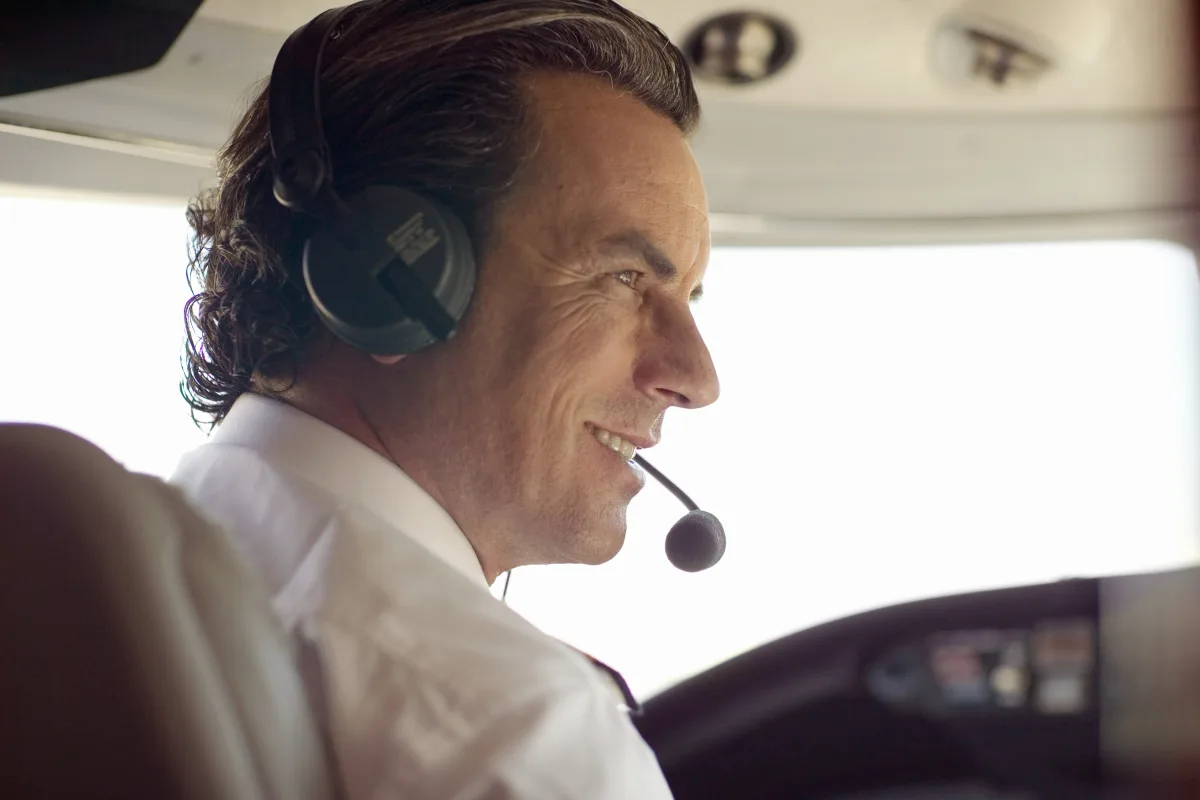
Level-D full-flight simulators: What they cost, how they work, why pilots experience emergencies there, and how the training is structured.
Professional Full-Flight Simulators — How Airlines Train Their Pilots
When an airline pilot completes their annual simulator check, they are not sitting in front of a gaming monitor with a joystick. They are seated in a multi-million-dollar machine that stands on hydraulic legs, moves in six axes, and features a visual system that deceives the human eye to the limits of perception. Full-Flight Simulators (FFS) are the crown jewels of pilot training — and a fascinating piece of engineering that goes far beyond what most people understand by "flight simulator."
The EASA/FAA Classification: What Do Levels A Through D Mean?
The EASA CS-FSTD(A) (Certification Specifications for Aeroplane Flight Simulation Training Devices) defines four qualification levels for Full-Flight Simulators. The FAA uses a comparable system under 14 CFR Part 60, also ranging from Level A through Level D. Each level builds on the previous one and permits additional training scenarios:
| Level | Motion System | Visual System | Application |
|---|---|---|---|
| Level A | 3 DOF (basic motion) | Day/night, basic scenery | Basic training, procedures |
| Level B | 3 DOF (enhanced) | Enhanced night scene | Extended training |
| Level C | 6 DOF | Day/dusk/night, ground textures | Recurrent training, ZFT possible |
| Level D | 6 DOF (highest fidelity) | Highest resolution, 200+ deg FOV, special effects | Complete training incl. type rating without aircraft |
Level D is the highest qualification level and the standard that modern airlines target for their simulator fleets. A Level D simulator is so realistic that a pilot can complete an entire type rating without ever flying the real aircraft. The first commercial flight with passengers takes place in the actual cockpit — under the supervision of an experienced captain, but prepared exclusively in the simulator. This concept is called Zero Flight Time Training (ZFT) and is only approved with Level D simulators.
The Major Manufacturers: CAE, L3Harris, and FlightSafety
The market for professional full-flight simulators is dominated by a few companies:
CAE (Canada) is the world's largest manufacturer and operator of flight simulators. The company not only builds the hardware but operates over 70 training centers worldwide with more than 300 full-flight simulators. CAE simulators are deployed by virtually every major airline. The product range extends from FFS Level D for wide-body aircraft to helicopter simulators for military customers.
L3Harris Technologies (following the merger with Thales Training & Simulation) is the second major global player. L3Harris supplies simulators to airlines, military, and flight schools. The Denton-Link series and the RealitySeven platform are among the most advanced systems on the market.
FlightSafety International (Berkshire Hathaway) operates training centers with over 400 simulators, primarily in North America. The focus is on business aviation and general aviation — types like Cessna Citation, Gulfstream, and Dassault Falcon are trained here. FlightSafety has developed the VITAL 1150, one of the most advanced visual systems available.
The Cost: $16 to $28 Million per Simulator
A single Full-Flight Simulator Level D costs between $16 and $28 million (15-25 million EUR) depending on the aircraft type. The cost breakdown includes:
- Cockpit replica: An exact reproduction of the aircraft cockpit, including all instruments, switches, levers, and displays. Parts often come from the same suppliers as real cockpit components. Cost: $3.3-5.5 million.
- Motion system (motion base): The hexapod with six hydraulic or electric actuators that moves the entire simulator. Cost: $2.2-4.4 million.
- Visual system: Projectors, mirror optics, or LED displays with associated image generation software. Cost: $3.3-6.6 million.
- Computers and software: Flight model, systems simulation, Instructor Operating Station (IOS). Cost: $2.2-4.4 million.
- Sound system: Speakers and transducers for realistic sound — engine noise, landing gear, wind noise. Cost: $550,000-1.1 million.
- Certification: The qualification process by EASA or FAA, including all tests and documentation. Cost: $1.1-2.2 million.
Add to this the ongoing costs: maintenance, calibration, software updates, facility costs, and personnel. An FFS consumes considerable power during operation — the motion base alone draws 50-100 kW depending on the system. Annual operating costs run $1.1-3.3 million per simulator.
The 6-DOF Motion System: Stewart Platform and Hexapod
The heart of the physical simulation is the hexapod, also known as the Stewart platform. Six actuators — either hydraulic or increasingly electric — connect the base platform to the simulator cabin. Through coordinated movement of these six cylinders, the cabin can be moved in all six degrees of freedom:
- Surge (longitudinal): Acceleration and deceleration
- Sway (lateral): Side forces during turns
- Heave (vertical): Climbing and descending, turbulence
- Pitch (nose up/down): Rotation about the lateral axis
- Roll (wings up/down): Rotation about the longitudinal axis
- Yaw (nose left/right): Rotation about the vertical axis
The critical technique: a hexapod cannot simulate sustained G-forces — the range of motion is insufficient. Instead, it uses the principle of onset cueing: the initial acceleration impulse is physically represented, then the simulator is imperceptibly returned to its neutral position (washout). The human vestibular system cannot perceive this slow return motion and interprets the initial impulse as sustained acceleration. Combined with the visual display, a convincing illusion is created.
Modern electric actuators are increasingly replacing traditional hydraulic systems. Electric motion bases are quieter, require less maintenance, are more precise, and consume less energy. CAE has introduced the Tropos 6000, a fully electric hexapod that sets the new standard.
The Visual System: How the Outside World Is Created
The visual system of a Level D simulator must cover a field of view of at least 200 degrees horizontal and 40 degrees vertical. The most common technology uses multiple high-performance projectors projecting onto a curved rear-projection screen. A typical setup uses five to seven projectors with edge-blending and warping technology.
The image generation (IG) is a discipline unto itself. Systems like Rockwell Collins EP-8100, CAE Tropos, or FlightSafety VITAL render photorealistic landscapes, airports, weather, and times of day in real time. The databases contain detailed models of the world's major airports — including taxiway markings, lighting, buildings, and terrain.
A recent trend: LED-based displays are increasingly replacing projectors. Direct LED walls offer higher contrast, no lamp replacement, and more uniform brightness. However, acquisition costs are still higher than projection systems.
Night scenes are particularly demanding: the light points of approach lighting systems (PAPI, VASI), runway lighting, and city lights must be exactly positioned and correctly rendered in intensity. A pilot flying an ILS approach at night at 200 ft decision height relies on the correct depiction of approach lights — in the simulator just as in the real aircraft.
"Everything is allowed to go wrong in the simulator. That is exactly what it is for. A pilot who knows emergency procedures only from the manual is not a safe pilot." — Training captain at a European airline
What Is Trained in the Simulator — and What Cannot Be Done in the Aircraft
The true value of the FFS lies in enabling scenarios that could never be trained in the real aircraft:
- Engine fire: Engine fire after takeoff — detection, extinguishing procedures, single-engine continuation or return. Unthinkable to practice in a real aircraft with passengers.
- Dual engine failure: Total failure of all engines (the "Sully" Hudson River scenario). Decision-making and glide landing are trained exclusively in the simulator.
- Hydraulic failure: Partial or total hydraulic failure. Alternate gear extension, gravity extension, manual reversion.
- Windshear: Dangerous wind shear during takeoff or landing. The correct recovery maneuver (TOGA, pitch 15 degrees, gear up) must be reflexive.
- TCAS Resolution Advisory: Evasive maneuvers following a near-collision per TCAS instruction. Correct compliance with RA commands is regularly tested.
- Rejected takeoff: Abort at V1 or just below. In a real, fully loaded aircraft — extremely hazardous, with brakes potentially overheating and tires blowing.
- Decompression: Cabin pressure loss — emergency descent to safe altitude, oxygen masks, emergency descent procedure.
- Icing: Ice accumulation on wings, engine inlets, and pitot tubes. Correct use of de-icing systems and recognition of ice-related performance degradation.
Training Types in the FFS
- Type rating: Initial training on a new aircraft type. Typically 30-40 hours in the FFS plus ground school. Cost: 25,000-50,000 EUR (~$27,500-55,000) depending on airline and type.
- Recurrent training: Annual refresher for all pilots. Two sessions of 4 hours, often combined with the Proficiency Check (PC). Mandatory under EASA Part-FCL; FAA requires recurrent training under Part 121/135.
- Line-Oriented Flight Training (LOFT): Complete gate-to-gate missions including ATC communication, CRM, and unexpected disruptions. LOFT is not graded — it focuses on teamwork and decision-making under realistic conditions.
- Emergency training: Specific emergency scenarios beyond standard recurrent. Evacuation procedures, ditching briefings, crew incapacitation.
- Operator Proficiency Check (OPC): Formal assessment of pilot proficiency, conducted by a Type Rating Examiner (TRE). Required every 6-12 months.
Costs for External Users: Hourly FFS Rates
Not only airlines operate full-flight simulators. Training centers also rent simulator time to:
- Private pilots seeking a type rating: The most affordable way to obtain a type rating. One hour in an FFS Level D typically costs $550-880 externally.
- Experience packages: Some operators offer simulator experiences for non-pilots. 30 minutes in an A320 or B737 simulator costs $110-220.
- Airlines without their own simulators: Smaller airlines rent simulator time from larger operators or specialized training centers.
Major Training Centers
Full-flight simulator training centers are located worldwide. Major facilities include:
- CAE: Training centers in over 35 countries, including Dallas, Montreal, London, Dubai, Singapore, and Amsterdam
- FlightSafety International: Primarily in North America — Dallas, Wilmington, Savannah, Wichita, and others
- L3Harris: Multiple locations in Europe, Americas, and Asia-Pacific
- Lufthansa Aviation Training: Frankfurt, Munich, Berlin, Zurich
- Airbus Training Centres: Toulouse, Miami, Singapore, Hamburg, Beijing
- Boeing Training: Seattle, Miami, London, Singapore, Shanghai
The Future: Cloud-Based Image Generation and AI
The simulator industry is on the cusp of a technology leap. Cloud-based image generation could replace expensive, dedicated IG hardware. Artificial intelligence is increasingly used to adaptively adjust training scenarios — the simulator identifies a pilot's weaknesses and generates targeted exercises for improvement. And the boundary between professional FFS and high-end desktop simulators is blurring: when an MSFS with Level D hardware cockpit delivers better visuals than a ten-year-old FFS, the question of certification arises anew.
For airlines, the FFS remains the indispensable tool of pilot training. The safety record of commercial aviation — with accident rates approaching zero in the developed world — is due in significant part to the quality of simulator training. Every pilot who safely executes an emergency landing has practiced that exact scenario dozens of times in the simulator. And that is precisely what makes the full-flight simulator one of the most worthwhile investments in all of aviation.
